
10 BOFU Blog Examples That Actually Drive Pipeline (and How to Reverse-Engineer Them)
Understand what makes BOFU content rank in AI engines through 10 proven examples.

If you have been closely following GEO/AEO/LLMO (or whatever you call it) - you already know that Top of the funnel (TOFU) content is getting cannibalized.
When a user searches for a generic query just to get information, it only makes sense that they read the details mentioned in AI overviews and back off.
But that’s NOT the case for Bottom of the funnel (BOFU) content. When a user searches for “best Asana alternatives” or “Mailchimp vs Klaviyo,” they’re past the research phase—they’re ready to make a decision. These queries signal purchase intent, not just curiosity.
If your content addresses their specific frustration—whether it’s pricing concerns, missing features, or implementation challenges—at that exact moment, you’re not just getting a click. You’re influencing the decision when it matters most.
In fact, people usually ask similar questions to AI engines, and no wonder AI engines are also looking for content that actually answers these high-intent questions.
That’s why BOFU content is the future of B2B content marketing. It’s the easiest way to influence your target audiences.
Being someone who always talks about BOFU content, here are 10 BOFU blog examples that I absolutely admire. Bonus: There are tips to reverse-engineer the same articles with actionable tips.
📌 TL;DR
TOFU is dying, BOFU is thriving: AI Overviews are cannibalizing 90-99% of informational content, but bottom-of-funnel content (comparisons, alternatives, solution pages) is what LLMs actually cite and recommend
10 BOFU examples analyzed: From Zapier’s unbiased Klaviyo vs Mailchimp comparison to Dock’s customer enablement guide—each with reverse-engineering tactics you can steal
Key patterns that work: Lead with buyer pain points, use actual user complaints as social proof, structure content around outcomes (not features), and include honest pros/cons even for your own product
The LLM advantage: When users ask ChatGPT “best X tools” or “X vs Y,” AI engines scrape Google’s top 10 rankings for citations. Rank there with BOFU content = LLM visibility
Your AEO strategy = BOFU SEO: Stop chasing traffic volume. Focus on revenue-driving content that influences decisions when buyers are ready to choose
BOFU Content Types At-A-Glance
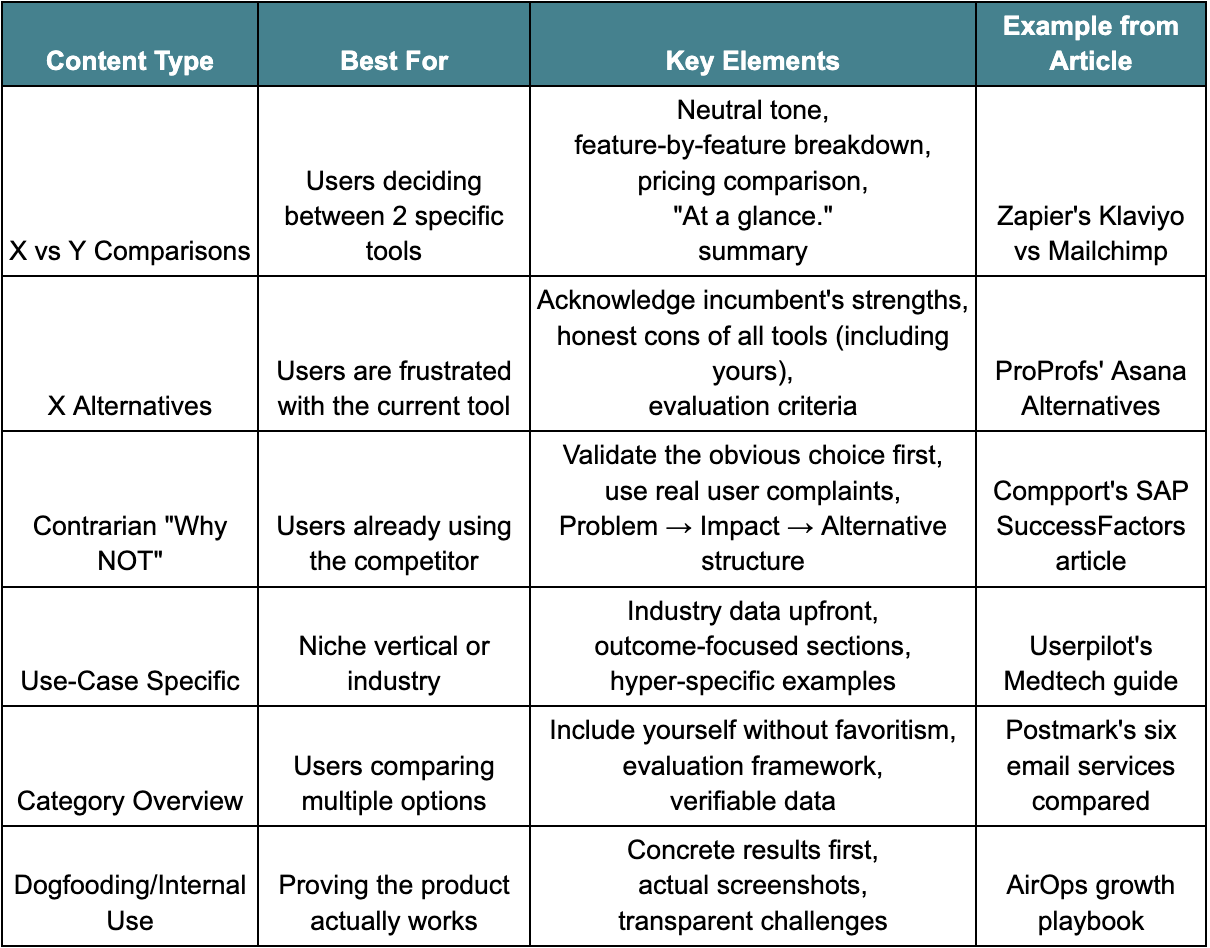
✅ Comparison Blogs - X vs. Y
#1 Klaviyo vs. Mailchimp - Published by Zapier
When it comes to BOFU blogs, I consider this article golden. I was introduced to this article about a year ago by an ex-client, back when I was freelancing as a BOFU writer. And, I kept going back to it for inspiration. In fact, I wrote about it in my newsletter too.
Zapier publishes this article - a tool that offers integrations with both Klaviyo and Mailchimp. Yet, Zapier has written this article from a completely neutral perspective and created a detailed comparison of all essential use cases that might matter to an email marketer.
The result? An unbiased comparison between two popular email marketing tools that actually help you make a decision.
How can you reverse-engineer it?
A no non-sense introduction that sets the context straight in the first sentence and establishes clearly that an email marketer has compared these two tools, i.e, the right ICP
Honestly, the “At a glance” comparison is specific enough for you to make a decision, it’s so carefully created. At the same time, for someone who wants to dive deeper, this comparison table is like an invitation to read further
The sub-heads are to-the-point. Each pointer gives you enough context on different use cases and which tool is better at it (along with relevant product screenshots)
Finally, a short yet convenient description of which tool you should select and why
#2 Supermetrics vs Whatagraph: Which is Right for You? - Published by Whatagraph
Though a comparison article, this one takes a completely different approach from the above Zapier article. This article is published by Whatagraph. However, unlike what might sound obvious, Whatagraph doesn’t really straightaway explain why it is a better choice than Supermetrics.
Instead, it shows examples and an honest comparison. By the end of this article, you will know exactly when Supermetrics is relevant and when Whatagraph is.
How can you reverse-engineer it?
The shortest intro followed by a quick list of pointers to establish the context
I liked this approach of discussing the fundamental differences. Since a lot of people make decisions based on these, it makes sense to keep this section at the top
Including “Who is Supermetrics and Whatagraph for?”, this section is also a good idea, so someone reading this can confirm whether the article matches their intent
Needless to say, the feature-based comparisons are detailed and on point along with annotated product screenshots
#3 Ahrefs vs Semrush: Which SEO Tool Should You Use - Published by Backlinko
Before coming across this article, I would have honestly thought that Ahrefs and Semrush are the mirror images of each other. However, that’s not the case, and this very impartial BOFU blog explains that. It follows a simple structure where it shortlists the key features content marketers and SEO professionals will be interested in, like keyword research, LLM visibility, backlink analysis, etc.. It provides you with an honest overview of which tool is better at what.
How can you reverse-engineer it?
I love a simple BOFU article structure that shows precisely what it promises - a feature by feature comparison along with product screenshots
The tone is humorous, easy to understand and to the point
Since pricing is always a key decision-making factor for tools this close to one another, this article does a great job comparing both tool’s pricing plans
✅ Alternatives - X Alternatives
#4 13 Asana Alternatives to Manage Your Projects Better in 2025 - Published by ProProfs
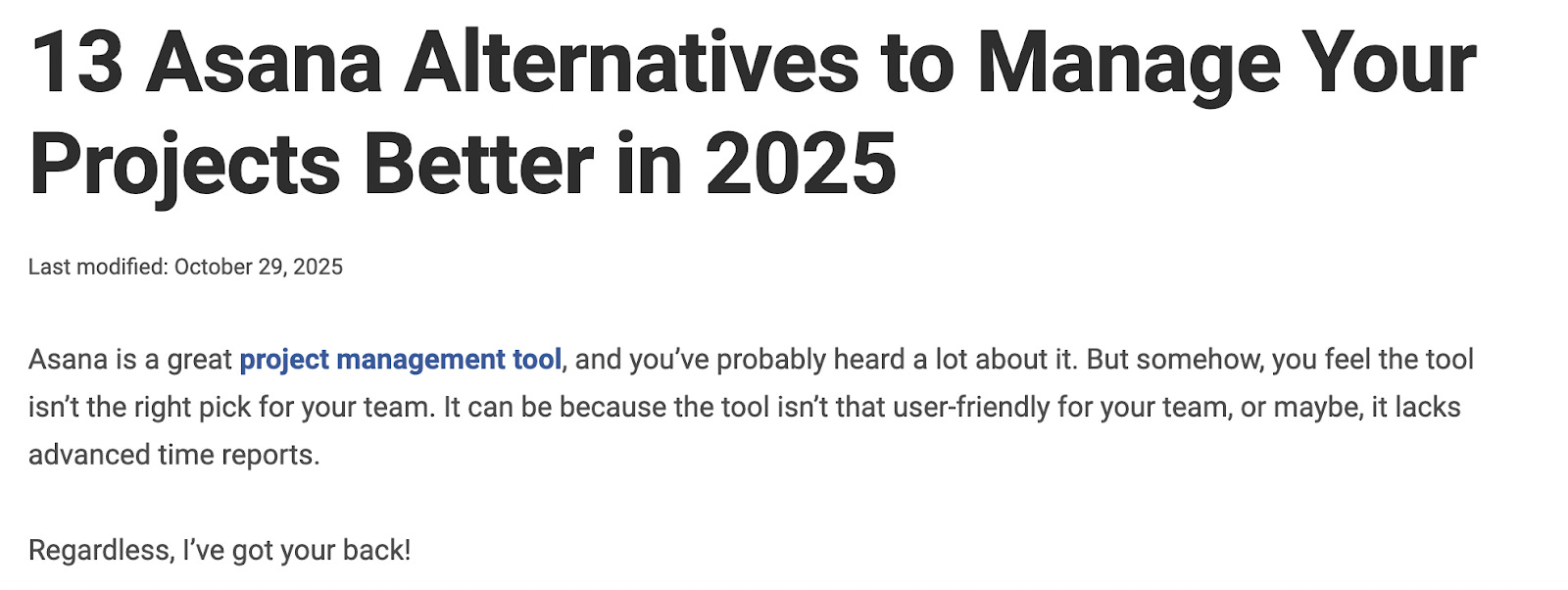
I have always admired ProProfs’ content. ProProfs’ BOFU content stands out because it’s well-structured, unbiased (there’s no bias towards their own product), and most importantly, they don’t shy away from talking about the actual cons of their own tool (Read “What you may not like” section under ProProfs).
How can you reverse-engineer it?
A simple introduction that addresses the advantages of Asana and respectfully moves on to talk about its potential challenges for a particular use group
A brief, defined structure that’s followed for all tools (including ProProfs)
Towards the end, this article explains the evaluation criteria for each tool. This is super important, so you don’t target a generic audience group
A smart approach to shortlist three tools at the end and explain which is suitable for whom
#5 Top 13 ClickUp Alternatives and Competitors in 2025 - Published by ClickUp
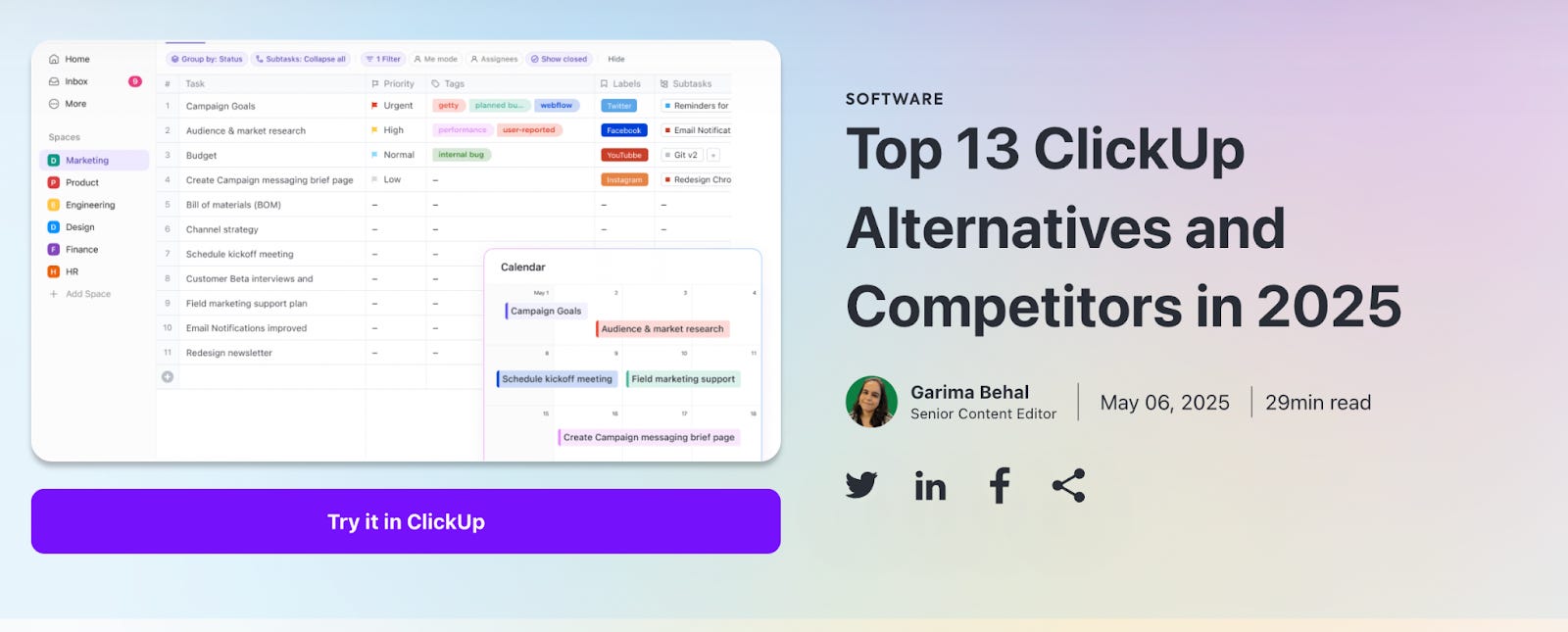
Why would ClickUp write about ClickUp alternatives, right? Well, that absolutely makes sense if you start reading the article. It’s ClickUp’s way of addressing the common reasons why people may switch from ClickUp to other tools.
While this might backfire for new startups, ClickUp pulled this off gracefully if you ask me. This article, targeted at small teams, clearly explains why ClickUp can be a good option for them. To add to that, it also delivers what it promised - a list of ClickUp alternatives.
How can you reverse-engineer it?
An honest “what should you look for in a ClickUp alternative” section that rightly explains some of the features that people think ClickUp might not offer
A detailed “Things to Consider Before Looking for a ClickUp Alternative” section that explains in the most detailed way about the ClickUp features that you wouldn’t want to miss out
While discussing about the alternatives, there is a dedicated section for every tool where its mentioned why ClickUp stacks up against that particular tool
Finally, at the end there is a product plug but that’s not fluff. It rightfully explains why ClickUp is still a better choice in the list
📚 BOFU Blog (Comparison and Alternatives) Templates you can use:
✅ BOFU Blog Types beyond Alternatives and Comparisons
#6 How Medtech Companies Can Improve User Experience with Userpilot - Published by UserPilot
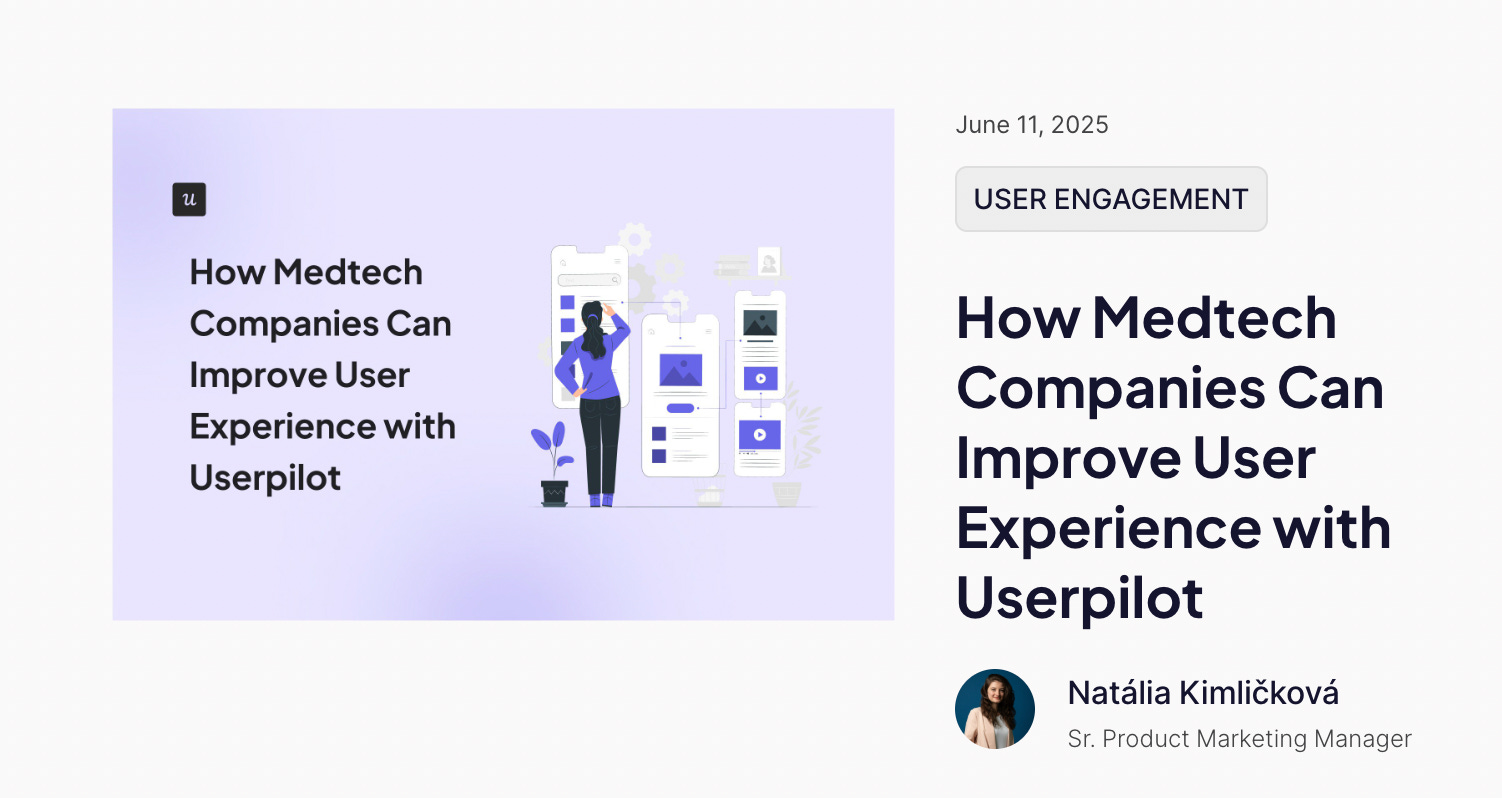
This is a use-case specific BOFU article that targets a niche vertical (medtech) and walks through exactly how Userpilot solves their unique challenges.
What makes this brilliant is that it doesn’t force-fit generic product features. Instead, it addresses real medtech pain points—78-fold pandemic adoption spike, 34.5% Month-1 retention (12.4 points below industry average), strict regulations, specialized training needs—and maps Userpilot features directly to those problems.
How can you reverse-engineer it?
Lead with industry-specific data that creates urgency. For example, in this case, McKinsey’s pandemic stats immediately signal “we understand your world”
Structure around customer outcomes, not product features. I love how each section is titled by what users can achieve (”Onboard and train users”), followed by the pain point with data (23.8% activation vs 37.5% average), then how Userpilot enables it
Use hyper-specific examples that speak to the ICP - not generic ones. For example, instead of “create walkthroughs,” the article uses headlines like, “Equip ICU teams with step-by-step walkthroughs so nurses can confidently use life-support dashboards in under ten minutes”
#7 5 Reasons Why You Should Not Manage Compensation in SAP SuccessFactors - Published by Compport

I might be biased for adding this, but hear me out on why I included it.
This is a contrarian BOFU piece that takes a bold stance: here’s why you shouldn’t use the market leader. It’s published by Compport, a SuccessFactors alternative (+ it integrates with the tool too), but it doesn’t read like a hit piece.
Instead, it methodically breaks down legitimate scenarios where SuccessFactors falls short—and by extension, where Compport excels. The title alone (”Why You Should NOT...”) is tempting enough to get clicks from people already frustrated with SuccessFactors.
How can you reverse-engineer it?
Open by validating the obvious choice before dismantling it (”Picture this: Your company already runs SAP SuccessFactors... the obvious choice seems clear”)
Address objections upfront with a dedicated “Common Hesitations” section before diving into problems
Use actual user complaints as social proof - Reddit screenshots and G2 quotes lend credibility since you’re not inventing problems
Structure each reason as Problem → What it means → The alternative for scannable, persuasive flow
Close with “The solution isn’t abandoning SAP entirely” to respect existing investments while positioning your product as a complement
#8 How We Use AirOps to Grow AirOps - Published by AirOps
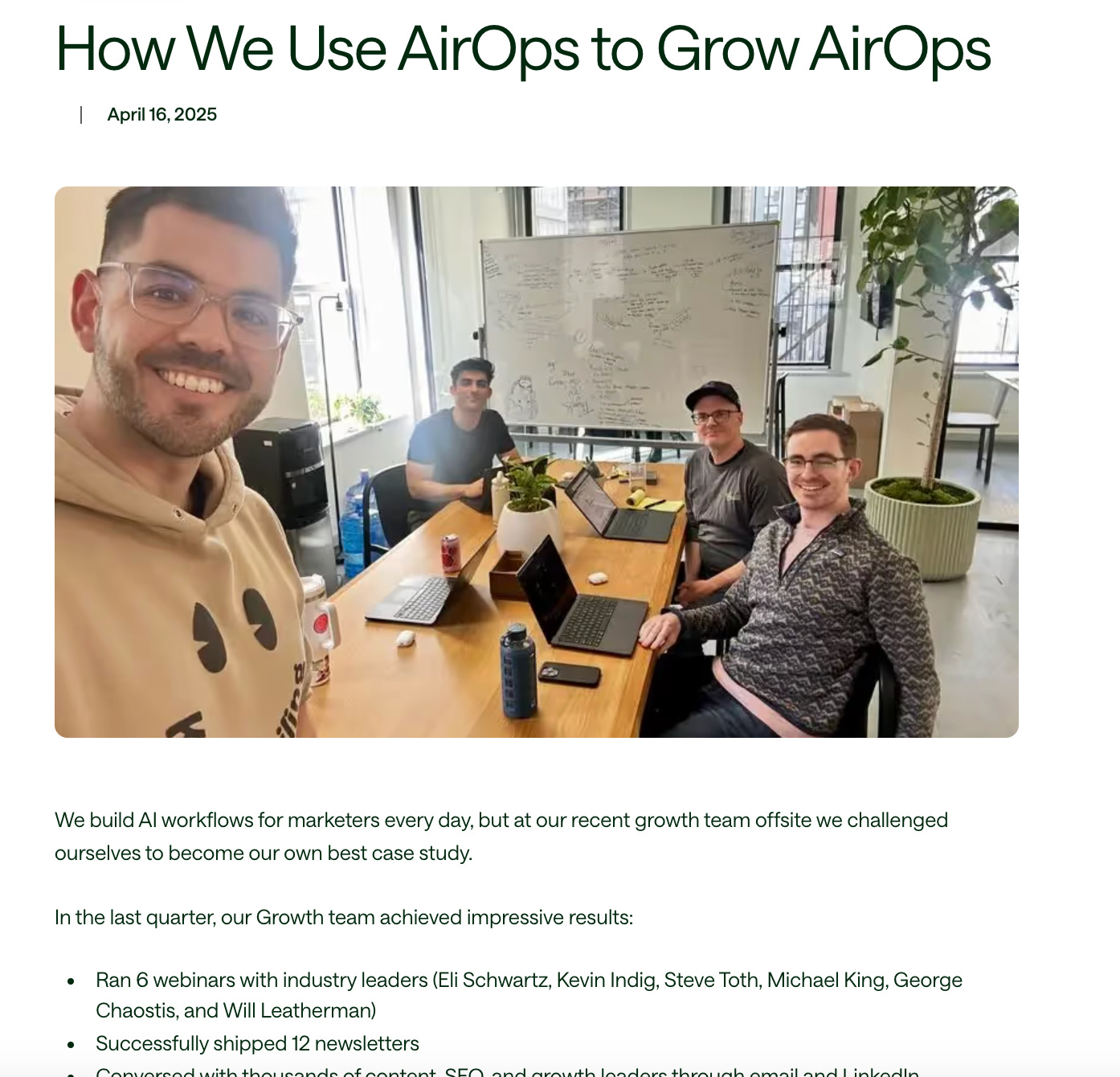
This is the “dogfooding” playbook—showing how AirOps uses its own product internally. It’s meta, transparent, and incredibly credible because it answers every prospect’s question: “Does this actually work, or is it just marketing?”
By pulling back the curtain on their own growth tactics (6 webinars, 12 newsletters, 50% increase in followers, 30+ growth experiments), AirOps demonstrates product value while creating a replicable framework that readers can adapt.
How can you reverse-engineer it?
Lead with concrete results upfront (6 webinars, 50% follower increase, 30+ experiments) before explaining how
Frame it as “Challenges We Faced” before solutions to acknowledge shared pain points
Structure each workflow identically: The Need → Input → How it works → Output → Impact with time saved
Include actual workflow screenshots showing real internal configurations, not polished marketing images
End with actionable framework (map content flow, spot bottlenecks, define inputs/outputs) readers can replicate
Multiple CTAs for different intent levels (strategy session, cohort, webinar, demo)
#9 6 transactional email services compared (and how to pick the right one) - Published by Postmark
Postmark has always been good with its BOFU strategy, and this article is one of the best ones.
Postmark doesn’t just compare itself to five competitors—it creates a genuine buying guide that helps developers and product teams evaluate transactional email providers based on what actually matters: deliverability, speed, developer experience, pricing models, and support.
The genius here is that Postmark positions itself as the trusted advisor who happens to also be an option, rather than being aggressively salesy about its product.
How can you reverse-engineer it?
Include yourself in the comparison without favoritism, with honest pros/cons in the same format as competitors
Add “What we’ve heard from customers who switched” boxes after direct competitors to subtly reinforce advantages
Write for your audience. For example, here the target readers are dev people, and hence Postmark uses technical language that they understand (webhook reliability, SMTP authentication, bounce handling)
Create an evaluation framework section at the end that helps readers decide while highlighting what you do well
Back up claims with verifiable data (public delivery stats, G2 reviews, Trustradius scores)
#10 How to introduce Dock to your customers - Published by Dock
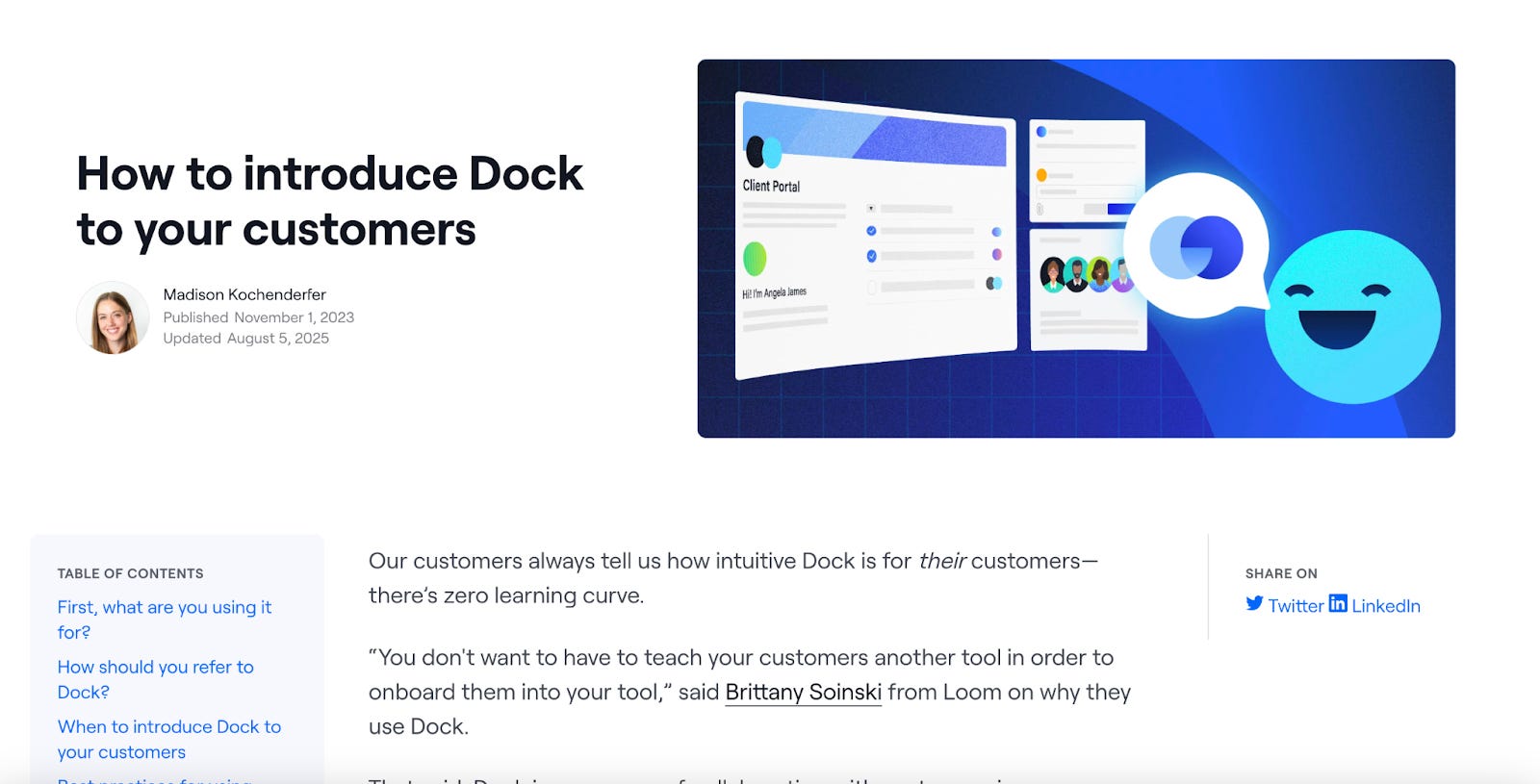
This is an enablement guide by Dock for its existing customers. A BOFU article aimed not at prospects, but at users who’ve already bought Dock and need to drive adoption with their own customers.
It’s brilliant because it removes a massive activation barrier: “I bought this collaborative workspace tool, but how do I get my clients to actually use it?”
By creating this guide, Dock increases product stickiness, reduces churn, and generates word-of-mouth as their users successfully onboard their customers.
How can you reverse-engineer it?
Start by addressing the post-purchase anxiety with questions customers are actually asking (”How should I refer to Dock? When’s the best time to introduce it?”)
Structure advice chronologically around customer touchpoints (end of sales call, before kickoff, in standard emails)
Feature customer quotes from recognizable brands (Loom, Assignar, Champify) explaining what works for them
Break best practices into numbered, actionable tactics with specific “Bad vs. Good” examples
Add visual screenshots showing exactly how to execute tactics
End with support resources rather than a sales CTA since these are already customers
🤖 BOFU Content is What LLMs Actually Prefer
Here’s something most content teams miss: while top-of-funnel informational content gets cannibalized by AI Overviews (90-99% of AI Overviews are triggered by informational intent), bottom-of-funnel content is actually “LLM preference content.”
When users ask ChatGPT or Perplexity questions like “best project management tools for remote teams” or “Asana vs Monday.com,” these AI engines need to cite sources—and they’re scraping Google’s top 10 rankings to do it.
The Data Backs This Up
From Clearscope’s webinar:
LLM preference content = comparison content, product pages, solutions pages, features pages, “X vs Y,” and “X alternatives”
LLMs don’t retrieve information independently—they scrape Google and Bing rankings
Perplexity’s citation order almost perfectly mirrors Google search rankings
The conversion pattern for B2B SaaS: AI search for discovery/narrowing down → Google for brand search → conversion
What This Means for Your Content Strategy
Focus on tracking AI prompts that actually recommend tools and solutions. Don’t waste time tracking prompts like “what is project management?” because those just spit out answers from training data without citing sources.
Instead, track bottom-of-funnel prompts:
“What are the best ABM platforms with AI capabilities?”
“Is X a good alternative to Y for [specific use case]?”
Classic BOFU queries that require brand recommendations
The AEO strategy is just BOFU SEO
Want to explain your AEO strategy to executives? It’s simple: it’s BOFU SEO. That’s the content LLMs prefer, cite, and recommend.
✨ What’s Next?
BOFU content isn’t just surviving the AI era—it’s thriving.
While informational content gets buried under AI Overviews, comparison pages, alternative articles, and solution-specific content, LLMs cite and recommend exactly that.
The examples above prove one thing: the future of B2B content isn’t about creating more—it’s about making what actually influences decisions when buyers are ready to choose.
Found something useful? Tag along by subscribing to the GrowthPact newsletter.
Need help with building and scaling a BOFU content strategy?
Give us a call/DM or wait for the next edition!